

AI systems are increasingly being asked to do more than generate text. They write code, operate websites, create media, invoke software, and coordinate work that continues after a single response ends.
That raises an architectural question that matters more as the models get better: should the capability belong to the model, or should it belong to the system around the model?
We think the stronger answer is the second one.
Tools should survive the model
Many AI workflows still bind capability to a particular product. A coding model can edit a repository because its environment gives it a coding harness. A research agent can browse because its environment gives it a browser. A design product can generate images because image generation exists inside that product.
That works, but it creates an architectural dependency: change the model and you may lose the capability.
A stronger system makes the tool independent of the intelligence using it.
The model reasons about what should happen. The execution layer owns the mechanics required to make it happen.
Neither needs to permanently own the other.
Ordinary AI conversations can become operators
This changes what a conversational AI interface can be.
A chat does not have to stop at producing advice that a human later carries out. If an authorized model has access to a sufficiently capable tool surface, the conversation can become the control interface for software running somewhere else.
The machine performing the work might be a cloud server, a workstation, or hardware sitting under someone's desk. The location matters less than the separation.
The model can express the intended outcome while another system owns file access, application execution, validation, storage, and verification.
A relatively simple request can then become:
The output should be more valuable than the preview
This distinction becomes especially useful in creative production.
Image generation can create a visual result quickly, but the image is usually the final artifact. A procedural 3D workflow can produce something different.
The rendered image can be only the proof.
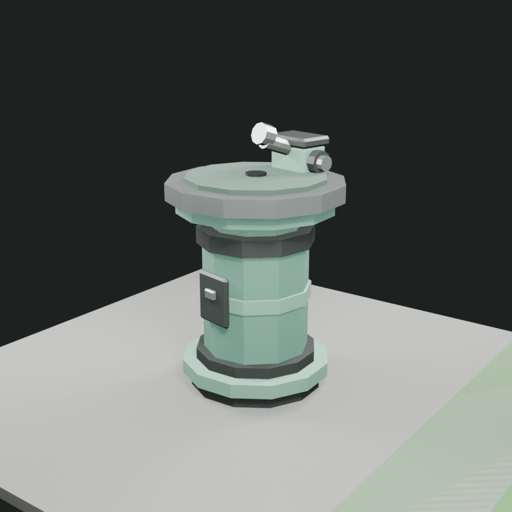
Behind that preview can exist editable geometry, separate materials, reusable components, alternate camera angles, scene-ready assets, game-ready source files, and future variations built from the same structure.
The preview becomes evidence that the underlying asset exists.
Fast iteration changes what AI can learn
The speed of the loop matters.
If every attempt is expensive, slow, or operationally difficult, an AI system gets relatively few opportunities to improve. If execution becomes cheap, failures become training material for the surrounding workflow.
A generated asset can reveal a compatibility problem. The next attempt can encode the correction. Geometry that looks acceptable from one angle can fail from another, leading the workflow to require multiple proof views. A component can float slightly above the ground, leading future builds to add grounding checks.
The useful pattern is:
That is more durable than asking a model to simply remember to do better.
This makes models increasingly interchangeable
Once the execution capability exists outside the model, more than one model can potentially use it.
One model may be better at visual reasoning. Another may be better at code generation. Another may be faster or cheaper for straightforward tasks. A newer model may replace all three later.
The production capability does not need to disappear when that happens.
The useful assets of an AI system increasingly exist around the model: state, permissions, tools, execution, verification, and learned constraints.
The model supplies intelligence to that system.
Local computers are becoming AI infrastructure again
Not every AI workload needs to run entirely in someone else's cloud.
Modern consumer computers already contain significant compute, storage, and specialized software. If AI models can securely request bounded work from those machines, existing hardware becomes part of the AI execution layer.
A computer that might otherwise sit idle can render, compile, analyze, transform files, run simulations, or operate specialized applications.
The cloud remains useful for connectivity and availability. But the actual work can happen wherever it makes the most sense.
The next step is pixels becoming geometry
Text-to-3D execution is useful. The larger opportunity is visual reconstruction.
Image generation is extraordinarily good at producing concepts quickly. What it does not naturally provide is a durable geometric representation of the thing it imagined.
The next generation of creative systems can connect those capabilities:
In that workflow, image generation becomes something closer to a concept artist. The 3D system becomes the manufacturing layer.
The final product is no longer only the picture that inspired the object.
It is the object.
AI products are becoming execution systems
The first generation of generative AI products primarily answered questions and generated media.
The next generation will increasingly operate persistent capabilities.
That changes the important question from, “What can this model do?” to, “What can any authorized model do through the system around it?”
Once capability is separated from a specific model, AI becomes easier to replace, easier to parallelize, and less constrained to one interface.
The model should be able to change.
The tools should remain.
And the runtime should belong to the system, not the conversation.
We are building this pattern in public.
Lensically is where we turn these operating ideas into products, tools, and digital systems you can actually use.
Explore the Lensically storefront